Not sure whether to replace? Pick your situation.
Tap the closest match for a plain-English next step. It is a guide, not a diagnosis.
Water Heater Size Finder
Answer five quick questions for a rule-of-thumb tank size and first-hour rating target. This is a planning guide, not a quote. A plumber confirms the final choice against your actual space, venting, gas or electric supply and local code.
Water Heater Installation Services in San Antonio
A water heater installation is the complete job of removing the old unit, setting a new one, and reconnecting water, fuel, venting, safety devices and drainage to current code. It is not only a tank swap. In San Antonio the real work often sits in the details: a cramped attic platform, a garage with a gas burner too low to the floor, a corroded vent, or a pressure problem that will kill the new tank early.
Stark Plumbing Solutions handles residential water heater installation and hot water tank replacement for gas, electric and heat pump tank heaters. For on-demand units, our tankless water heater service page goes deeper. If your current heater only needs a part, our water heater repair team can tell you honestly whether repair is worth it.
What is included in a good installation
- Removal and haul-away of the old tank
- New water shutoff valve and flexible connectors
- New T&P valve with a proper discharge pipe
- Drain pan and pan drain where required
- Expansion tank when the system is closed
- Gas, vent or electrical connections to code
- Leak, gas and temperature testing
What to question in an estimate
- No mention of a permit
- Reusing old flex connectors or a rusty vent
- No expansion tank on a closed system
- A tank sized only by what was there before
- Vague wording like "misc. materials"
Signs Your Water Heater Needs Replacement
Your water heater likely needs replacement if it is more than about 10 to 12 years old and leaks from the tank body, rusts at the base, or fails to keep up even after basic repairs. Age matters, but condition matters more.
Common warning signs
- Water pooling at the base. A leak from the tank itself cannot be patched. Fittings and valves can leak too, so we check before calling it.
- Rusty or brown hot water. If only the hot side is discolored, the tank lining or anode rod may be failing.
- Rumbling or popping. Sediment baked onto the bottom traps steam bubbles. San Antonio hard water makes this common.
- Hot water runs out quickly. Scale can fill the bottom of the tank and reduce usable hot water.
- Repeated repairs. A second or third repair on an old tank usually costs more over time than replacement.
- Age on the data label. The serial number usually encodes the manufacture date. Send us a photo and we can read it.
Why tanks fail
A steel tank is protected by a glass lining and a sacrificial anode rod that corrodes first. Once the rod is spent, the tank wall begins to corrode. Hard water speeds up scaling, high pressure stresses the tank, and a missing expansion tank makes pressure swings worse. See the San Antonio section for local factors.
What to Do Right Now if Your Water Heater Fails
If your water heater is leaking or flooding, shut off the cold water to the heater, turn off its power or gas, and call a licensed plumber. Do these steps in order and stay safe.
- Smell gas? Leave first.Leave the home, avoid switches and flames, then call 911 and CPS Energy from outside. Do not try to find the leak yourself.
- Turn off the energy.For electric, switch off the breaker (only if the floor around the panel is dry). For gas, turn the control knob to the off or pilot position.
- Close the cold water shutoff.Turn the valve on the cold pipe at the top of the heater clockwise. If it will not turn, close the main shutoff.
- Contain the water.Use towels, a wet vacuum and a bucket under the T&P discharge pipe if it is dripping.
- Do not drain a hot tank carelessly.Water in the tank can scald. Let it cool before opening a drain valve.
- Call us.Call (210) 898-9754 for emergency help, or text a photo of the label and leak.
Gas vs. Electric Water Heaters
Gas water heaters usually heat faster and recover faster, while electric water heaters are simpler to install and need no venting. In San Antonio, where most homes have both gas and electric service, the best choice depends on what your home is already set up for, your utility rates and how much hot water you use.
| Factor | Gas tank | Electric tank | Heat pump (hybrid) |
|---|---|---|---|
| Recovery speed | Fast | Slower | Slowest in heat pump mode |
| Venting | Required (flue) | None | None, but needs airflow |
| Power needed | Gas line; small electric for power vent | Dedicated 240-volt circuit | 240-volt circuit (some models 120-volt) plus condensate drain |
| Upfront cost | Moderate | Lowest to moderate | Highest |
| Operating cost | Depends on gas rates | Higher than heat pump | Lowest electric option |
| Outage behavior | Standing-pilot models still heat in an outage | No heat without power | No heat without power |
| Safety checks | Gas leaks, CO, combustion air | Wiring and breaker size | Space, airflow, condensate |
How to choose
- Stay with gas if you have a good vent path and gas line, and you want fast recovery for a large household.
- Choose electric if there is no gas service, venting is difficult, or the heater sits in a closet or alcove where a flue is a problem.
- Consider a heat pump if you have the space and want lower electric use. See heat pump water heaters below.
Gas work, including capping or extending a gas line, must be done by a licensed plumber. Our gas line repair team handles the gas side when a heater changes fuel.
Can You Switch From Gas to Electric (or Back)?
Yes, you can usually change from gas to electric, but it is a bigger project than a like-for-like swap. The home needs enough panel capacity and a dedicated 240-volt circuit, and the old gas line must be capped and pressure tested by a licensed plumber.
Gas to electric
- An electrician or licensed plumber with the right scope checks panel capacity and wire size.
- A dedicated circuit and breaker are run to the heater location.
- The gas line is capped at a proper point, not just closed at the valve.
- The old flue is removed or sealed so it does not leak air or let animals in.
- A permit and inspections are typically needed for the electrical and plumbing work.
Electric to gas
This needs a gas line sized for the new appliance, a vent path to the outdoors and combustion air. In older San Antonio homes, a missing gas stub or a blocked chimney can make this difficult or not worth the cost.
Selecting Tank Size and Capacity
The right tank size is determined by how many people live in the home, how many bathrooms you have, how much hot water you use at the same time, and the heater's first-hour rating. For a typical San Antonio household, a 40 to 50 gallon tank fits 2 to 4 people, and larger homes may need 50 to 80 gallons.
Use the Size Finder above for a rough start. The numbers below are standard rules of thumb, not a guarantee.
| Household | Typical tank size | First-hour rating target |
|---|---|---|
| 1 to 2 people, 1 bath | 30 to 40 gallons | 40 to 55 gallons |
| 3 to 4 people, 2 baths | 40 to 50 gallons | 60 to 75 gallons |
| 4 to 5 people, 2.5 to 3 baths | 50 to 65 gallons | 70 to 90 gallons |
| 5 or more people, 3+ baths | 65 to 80 gallons | 90 gallons or more |
What factors determine water heater size
- Peak demand. The busiest hour of your day is what matters, not the daily total.
- First-hour rating (FHR). This is the number of gallons the heater can supply in an hour starting full. It is on the yellow EnergyGuide label and is more useful than tank gallons alone.
- Fuel type. Gas recovers faster than electric, so a gas 40-gallon can beat an electric 50.
- Fixtures. Soaker tubs, rain showers and multiple showers need more capacity.
- Space and venting. Not every home can hold a larger tank. Height, width, door size and platform limits count.
- Cold inlet temperature. Colder incoming water in winter means more heating work for the same tap.
Replacing an Old Water Heater: What Changes With Today's Codes
Replacing an old water heater means the new unit must meet today's code, even when the old one was legal when it was installed. That is why a like-for-like swap often includes upgrades such as a drain pan, an expansion tank, new flex connectors, an elevated burner in a garage, and corrected venting.
Upgrades that often come with replacement
- Flammable vapor ignition resistant (FVIR) gas heaters. Modern gas tanks are built to resist igniting flammable vapors near the floor.
- Higher efficiency. New federal standards have pushed efficiency up, and many new tanks are slightly taller or wider than older ones. Measure your space.
- Vent materials. Old galvanized or corroded vent pipes may need to be replaced.
- Drain pan and pan drain. Required in many installations where a leak could damage finished space, such as attics, closets and upper floors.
- Insulated pipes and shutoff valves. New full-port valves make future service easier.
Replace now or wait until it fails?
Replacing a healthy but old heater on your schedule is usually less stressful and often less expensive than waiting for a failure. A failed tank in an attic can cause ceiling and insulation damage, and an emergency job leaves less room to compare options.
- Over 10 years old and showing rust or noise
- You can compare models and estimates
- No wet floors or drywall damage
- Leaking from the tank body
- No hot water and the tank is old
- T&P valve repeatedly discharging
If your heater is on the fence, our water heater repair page explains when a repair makes sense.
Water Supply, Gas and Vent Connections
A proper installation connects four things correctly: cold water in, hot water out, the energy source (gas or electric), and the exhaust or airflow path. Mistakes here cause leaks, poor performance and safety hazards.
Water connections
- Shutoff valves. A new quarter-turn valve on the cold supply lets you isolate the heater in an emergency.
- Flexible connectors. Stainless braided connectors are easier than hard pipe in tight spaces. They are replaced, not reused.
- Dielectric unions or nipples. These separate dissimilar metals, such as copper and steel, to slow galvanic corrosion at the fittings.
- Expansion tank. See the next section.
Gas connections
- Gas line sizing. The pipe must carry enough gas for the heater's BTU rating plus anything else on that line.
- Sediment trap (drip leg). A short vertical pipe that catches debris before it reaches the gas control.
- Approved connector and shutoff. A listed flexible gas connector and an accessible shutoff valve.
- Leak testing. Every gas joint is tested before the heater is lit.
If there is any question about gas capacity or piping condition, our gas line repair service covers it.
Venting and combustion air
Gas heaters must exhaust carbon monoxide and combustion gases safely. The right vent type depends on the heater.
| Vent type | How it works | Where it is common |
|---|---|---|
| Atmospheric (natural draft) | Hot gases rise through a metal flue to the roof | Older homes with a roof vent |
| Power vent | A fan pushes exhaust out through PVC or similar pipe, often through a wall | Closets and garages without a roof path |
| Direct vent | Sealed system that draws air in and exhausts out through a pipe pair | Tight homes and closets |
| Electric / heat pump | No combustion vent | Any space with the right clearance |
Combustion air matters too. A gas heater in a small closet needs enough fresh air openings, or a sealed system, so it burns cleanly and does not pull exhaust back into the room.
Expansion Tanks, T&P Valves, Drain Pans and Other Safety Parts
The safety parts around a water heater are not optional extras. The T&P valve, discharge pipe, expansion tank and drain pan each protect against a specific failure.
Expansion tank and thermal expansion
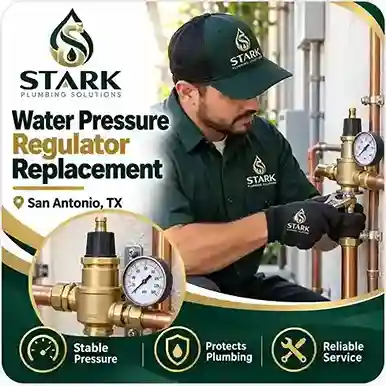
Water expands when it is heated. If your home has a pressure reducing valve (PRV) or a backflow device, the water has nowhere to go and pressure can spike. This is a closed system, and an expansion tank gives the extra water a place to go. Without it, pressure spikes can shorten the heater's life, cause the T&P valve to drip and damage fixtures. Many San Antonio homes have a PRV, so an expansion tank is commonly recommended. See our pressure regulator replacement page for the pressure side.
Temperature and pressure (T&P) relief valve
The T&P valve opens if the tank gets too hot or the pressure gets too high. It must have a discharge pipe that runs downward to a safe location with no threads at the end and no cap or plug. Never block or cap a T&P valve.
Drain pan and pan drain
A drain pan catches a slow leak or condensation. In attics, closets and upper floors a pan drain line carries the water to a safe spot, often outside. Without it, water drips through drywall before anyone notices.
Anode rod
The anode rod is the sacrificial metal rod that protects the tank lining. Checking and replacing it can extend tank life, but only if it is done before the rod is fully consumed. A new tank's warranty may require specific care.
Garage and ignition-source rules
Gasoline vapors are heavier than air and can settle near the floor. When a gas heater is in a garage, codes typically require the burner or ignition source to be raised above the floor (commonly 18 inches) or the heater to be a listed FVIR model, and often protected by a post or barrier. We confirm the current requirement for your location.
Our Step-by-Step Installation Process
Our process is simple: assess, write the estimate, get your approval, install, test, and explain. Nothing is started until you approve the written estimate.
- Talk and photosCall or text photos of the heater, its label and the location. We ask about hot water habits.
- On-site checkWe check the space, vent, gas or electric supply, pressure and shutoffs.
- Written estimateYou get equipment, parts, permit, haul-away and warranty terms in writing. No work starts before you approve.
- Protect the homeWe lay down protection, shut off water and fuel, and drain the old tank.
- Remove and prepThe old tank is disconnected and removed. We inspect the vent, platform and piping.
- Set and connectThe new heater is set with new valves, connectors, T&P discharge, pan and expansion tank when needed.
- Fill and purgeThe tank is filled, air is purged and every joint is checked for leaks.
- Light or power upGas is tested for leaks, the burner is lit and combustion and draft are checked. Electric units get verified wiring and element operation.
- Set temperatureWe set the thermostat, commonly to 120°F, and explain the controls.
- Walk-throughWe show you the shutoff valve, how to read the data label, and what to register for warranty. We also arrange the permit inspection as part of the job.
If we find something unexpected, such as a rotted platform or corroded gas pipe, we stop, show you, and update the written estimate before continuing.
Installation Testing and Safety Requirements
After installation, a water heater should pass a set of leak, gas, venting, pressure and temperature checks before it is left running. This is the part of the job that protects your family and often the part that cut-rate installs skip.
- Leak test. All water joints and valves are checked under pressure.
- Gas leak test. Every gas joint is tested with a leak detection solution or gauge before lighting.
- Draft and CO check. We verify exhaust flows out of the vent and not into the room. A carbon monoxide alarm nearby is strongly recommended.
- Pressure check. We measure static pressure and confirm the expansion tank is charged to match.
- T&P and discharge. We confirm the valve and pipe are installed correctly and unobstructed.
- Temperature check. We confirm water at a fixture is near the setpoint.
- Electrical check. For electric heaters, breaker size and wire gauge must match the nameplate.
Temperature setting and scald risk
The commonly recommended setting is 120°F, which reduces the risk of scalding and saves energy. At 140°F, a serious burn can happen in seconds, especially for children and older adults. If you want to guard against bacteria in a tank, discuss options with us instead of simply turning the heat up. Tempering valves are an option when higher storage temperatures are needed.
Heat Pump Water Heaters and Efficiency (UEF)
A heat pump water heater, also called a hybrid, moves heat from the surrounding air into the tank instead of generating it directly, so it can use far less electricity than a standard electric tank. It is a good fit for homes with the right space and a warm climate like San Antonio's.
What a heat pump water heater needs
- Space and airflow. Many models need roughly 700 to 1,000 cubic feet of air around them, or ducting, and clearance above for the unit. A closet usually needs louvered doors or ducts.
- Condensate drain. The unit pulls moisture from the air, so it needs a drain or pump.
- Electrical supply. Most use a 240-volt circuit. Some use 120 volts. We check your panel.
- Noise and cooling. It is about as loud as a dehumidifier and makes the nearby space cooler. A garage is often a good location. Attics can get too hot for good efficiency.
- Height. They are taller than standard tanks.
Reading efficiency: UEF
The Uniform Energy Factor (UEF) is the standard efficiency rating for water heaters. A higher UEF means less energy to deliver the same hot water. Look at the EnergyGuide label for estimated yearly energy cost, and consider whether a utility rebate or a tax credit applies. Check current programs before buying, because they change.
Water Heater Installation Cost Factors in San Antonio
Water heater installation cost depends mainly on the type and size of heater, the condition of the existing connections, venting needs, the location in the home and permit requirements. The ranges below are general industry ballpark figures for planning only. They are not a Stark quote, and your written estimate governs.
| Job type | General industry ballpark (installed) | What moves the price |
|---|---|---|
| Standard electric tank, 40 to 50 gal | About $1,200 to $2,500 | Circuit condition, access, pan, expansion tank |
| Standard gas tank, 40 to 50 gal | About $1,400 to $2,800 | Venting, gas line, combustion air |
| Power vent or direct vent gas tank | About $2,500 to $4,500 | Vent run length, electrical outlet, wall penetration |
| Heat pump water heater | About $2,500 to $5,500 | Space, condensate, circuit, rebates |
| Attic or hard-access install | Add labor over a standard job | Platform, pan drain, hauling equipment |
| Fuel conversion (gas to electric) | Varies widely | Panel capacity, new circuit, gas capping |
Common add-ons, explained up front
- Expansion tank
- Drain pan and pan drain line
- New shutoff valves and connectors
- Vent replacement or repair
- Permit fee and inspection
- Haul-away of the old unit
- Platform or stand repair
San Antonio Factors: Hard Water, Pressure, Soil and Older Homes
San Antonio's water and housing stock shape how long a water heater lasts and how it should be installed. Local conditions are a main reason heaters here can wear out sooner than the brand's marketing suggests.
- Very hard water. San Antonio water carries high calcium and magnesium from the Edwards Aquifer. Scale builds in the tank and on elements, wastes energy and can shorten life. A water softener or periodic flushing helps. Softening can also affect warranty and anode rod choices, so ask.
- Pressure. SAWS pressure can range widely by neighborhood, and 80 psi is the commonly recommended maximum for homes. The pressure regulator on your side is your responsibility, not SAWS. High pressure strains the tank and fittings. See water pressure repair.
- Caliche and expansive clay soil. Soil movement can shift foundations and stress pipes. A slab leak can mimic a water heater problem, so we check lines when something does not add up. See leak detection.
- Older housing stock. Homes with older galvanized pipe, copper pinholes or polybutylene (used roughly 1978 to 1995) may need pipe work. Our repiping service covers that.
- Attics, garages and closets. Locations that require pans, platforms and venting care.
Seasonal Planning for Water Heaters in San Antonio
The best time to replace a water heater is before a season that stresses it. In San Antonio, that means winter cold snaps and summer high demand.
Winter
Colder incoming water means the heater works harder. The February 2021 winter storm showed that exposed pipes and attic heaters can freeze and that power or gas outages can leave homes without hot water. Insulate exposed hot and cold lines, know your main shutoff, and see our frozen pipe repair page.
Summer
Higher demand from guests, laundry and long showers can push an undersized tank. Attic heaters sit in very hot spaces, and heat pump water heaters work well in warm air. Summer is a good time for a planned replacement.
Spring
Check the base for rust and the T&P discharge pipe for stains. Schedule a flush if the tank is not too old. A good time to compare options without an emergency.
Fall
Before the first cold front, test shutoff valves and check pilot lights or elements. Replace an aging tank before winter demand and busy schedules.
Checklists: Before We Arrive and Questions to Ask Any Plumber
Before we arrive
These steps make the visit faster and help us give a more accurate estimate.
· Tip: screenshot this list.
Questions to ask any plumber before hiring
· Tip: screenshot this list.
Why You Should Not Install a Water Heater Yourself
- Gas and carbon monoxide. A bad gas joint or poor vent can leak gas or let carbon monoxide into the home. Never attempt gas work yourself.
- Scalding. A wrong thermostat setting or missing mixing valve can cause burns.
- T&P valve and pressure. A blocked or incorrect relief valve can turn an overheated tank into a serious hazard.
- Electrical. Wrong wire size or breaker can overheat. Water and live wiring are dangerous together.
- Permit and code. Texas plumbing work is generally done by licensed plumbers, and the City typically requires a permit and inspection.
- Voided warranty. Some manufacturers will not honor a warranty on a non-professional installation.
- Insurance. If a DIY install causes a fire or flood, an insurer may question the claim. Check your policy.
- Flooding. A bad connector or missing pan can ruin ceilings and floors quickly.
The honest answer is simple: call a licensed plumber. Our team installs water heaters daily and handles the permit, testing and haul-away.
Permits, Codes and Licensing
In San Antonio, replacing a water heater typically requires a plumbing permit from the City and an inspection, and the work should be done by a licensed plumber. We confirm the current requirement for your address before the job.
- Licensing. Plumbing in Texas is regulated by the Texas State Board of Plumbing Examiners. Ask any plumber for their license number and look it up at tsbpe.texas.gov.
- Permit. The City of San Antonio typically requires a permit for a water heater replacement. We include it in the written estimate.
- Inspection. An inspector may check venting, gas piping, T&P discharge, pan drain and expansion control.
- Codes. Installations follow the plumbing code adopted by the City. Rules can change, so we verify them each time.
- Warranty registration. Register the new heater with the manufacturer, often within a short window, and keep the receipt and permit record.
Unpermitted work can cause trouble when you sell the house, file an insurance claim or have a future inspection.
How Our Estimates Work: No Surprises
Our estimate process is built around no surprises: you get a written estimate before work starts, you approve it, and if the scope changes we stop and talk first.
- Share the factsCall or text photos of the heater, label and area. Photos often speed up the estimate.
- Written estimateEquipment, labor, permit, parts and haul-away are listed. Warranty terms are listed on your estimate.
- Your approvalNothing starts until you say yes.
- Scope changesIf we find a hidden problem, we stop, show you and explain options before any extra work.
- Final walk-throughWe review the work, controls and paperwork with you.
We do not quote prices in this guide because every home is different. Any ranges on this page are general industry figures.
Planning a bigger project? Our bathroom remodel plumbing and new construction plumbing pages show how we coordinate with other work.
Emergency No-Hot-Water Replacement
If your water heater fails and you have no hot water, you can still make a good decision quickly. Call (210) 898-9754 for emergency help, and we will explain whether repair or replacement makes the most sense.
- Shut off the water, gas or electric as described above.
- Send a photo of the label and the leak.
- Ask about equipment that is available and compatible with your space and venting.
- Ask whether a same-size like-for-like swap is practical or whether code changes are needed.
For a burst pipe, a flooding heater or any plumbing emergency, see our emergency plumber page. If the water heater leak is caused by a broken line, our water line repair team can help. Many homeowners also ask about a hot water recirculation pump during a replacement to cut wait time at the tap.
Water Heater Myths vs. Facts
| Myth | Fact |
|---|---|
| A new heater lasts 20 years. | Most tank heaters last roughly 8 to 12 years, sooner in hard water with high pressure. |
| Turning it up gives more hot water. | It mostly raises scald risk and energy use. Size and recovery rate decide capacity. |
| Any plumber can skip the permit. | The City typically requires a permit, and skipping one can cause problems later. |
| Bigger tank is always better. | Oversizing costs more. First-hour rating is what matters. |
| A dripping T&P valve is normal. | It usually signals pressure or temperature trouble. Never cap it. |
| Electric is always cheaper than gas. | Depends on rates, the model and hot water use. A heat pump can beat both. |
| Flushing fixes every old tank. | Flushing helps, but it cannot repair a corroded lining. |
Water Heater Installation FAQs for San Antonio Homeowners
How do I know if my water heater needs replacement?
Your water heater likely needs replacement if it is 10 to 12 years old or older and leaks from the tank, shows rust at the base or in the hot water, rumbles loudly, or runs out of hot water quickly. A leaking tank body cannot be repaired. Text us a photo of the data label and the area, and we will tell you what we see and whether repair is worth considering.
Can I change from gas to electric?
Yes, many homes can change from gas to electric, but it requires a dedicated 240-volt circuit with enough panel capacity, and the old gas line must be capped and tested by a licensed plumber. A permit and inspection are typically required. A heat pump model can cut electric use. We confirm feasibility on site before giving a written estimate.
What factors determine water heater size?
Water heater size is determined by the number of people, bathrooms, how much hot water runs at the same time, the fuel type and the first-hour rating on the EnergyGuide label. A 40 to 50 gallon tank suits many 3 to 4 person homes. Available space and venting can also limit size. Use the Size Finder on this page as a starting point.
How long does water heater installation take?
Most standard replacements take a few hours, but the time depends on access, venting, fuel type and any code upgrades. Attic installs, fuel conversions and vent changes take longer. We give a timeline in the written estimate. After installation, a permit inspection may be scheduled separately.
Do I need a permit to replace a water heater in San Antonio?
A permit is typically required to replace a water heater in San Antonio, and the work should be done by a licensed plumber. Rules can change, so we confirm the current requirement for your address and include the permit in the written estimate. Unpermitted work can cause problems for insurance and home sales.
What size water heater do I need for a family of four?
A family of four usually does well with a 50 gallon gas or electric tank, or a 40 gallon gas model with a strong first-hour rating. If you have three or more bathrooms or run several things at once, 65 gallons may be a better fit. Confirm with a plumber against your space.
Do I need an expansion tank with a new water heater?
You need an expansion tank if your plumbing is a closed system, which is common when a pressure reducing valve or backflow device is installed. Water expands when heated, and without a place to go, pressure can rise and damage the heater or fixtures. We test your pressure and recommend it when needed.
What temperature should I set my water heater to?
A common recommendation is 120 degrees Fahrenheit, which lowers scald risk and saves energy. Higher settings can burn skin in seconds, especially for children and older adults. If you have special health needs, talk to us about a tempering valve rather than raising the tank temperature.
Is it better to replace a water heater before it fails?
Yes, replacing before failure is usually better because you can compare options, choose a time and avoid water damage. A tank that is over 10 years old and showing rust or noise is a good candidate. If it already leaks or you have no hot water, call (210) 898-9754 for emergency help.
Why do water heaters fail faster in San Antonio?
Very hard water leaves scale in the tank, and high or fluctuating pressure stresses it. Heaters in hot attics can also wear faster. A water softener, correct pressure at 80 psi or lower, an expansion tank and anode rod care can help a new heater last longer.
Can a water heater go in a garage in San Antonio?
Yes, but a gas heater in a garage typically must have the ignition source raised above the floor or be an FVIR-listed model, and may need protection from vehicles. Electric and heat pump models avoid the ignition concern. We confirm the current code and your space before installing.
What does a heat pump water heater need?
A heat pump water heater needs open air space or ducting (often roughly 700 to 1,000 cubic feet), a condensate drain, a suitable electrical circuit and vertical clearance. It works well in a garage or large utility room. A tight closet usually needs louvered doors or ducts. We check the space first.
Will you haul away my old water heater?
Yes, haul-away of the old tank is part of a standard replacement unless your written estimate says otherwise. Ask to confirm it is included so there are no surprises. We also check that the old flex connectors, valves and vent are replaced or safely reused.
Should I get a tankless water heater instead?
Tankless can be a good choice for some homes, but it needs the right gas line size, venting, and water treatment in hard water. A tank heater is often simpler and costs less to install. See our tankless water heater page for sizing and maintenance details, or call us to compare.
About This Page and Our Sources
Sources and further reading:
- U.S. Department of Energy: Sizing a New Water Heater — first-hour rating and sizing basics
- U.S. Department of Energy: Heat Pump Water Heaters — efficiency and installation considerations
- ENERGY STAR: Residential Water Heaters — efficiency labels
- Texas State Board of Plumbing Examiners — verify a plumber's license
- San Antonio Water System (SAWS) — water quality, pressure and customer-side responsibility
- CPS Energy — gas safety and service restoration
- City of San Antonio Development Services — permit information
Costs, timelines and code requirements vary by home, equipment and the City of San Antonio permit rules in effect at the time of the work. Nothing on this page replaces an on-site inspection by a licensed plumber. Stark Plumbing Solutions is not affiliated with SAWS, CPS Energy or any manufacturer named on this page.